
 Posted by
 What is an archive? How do archives shape our understanding of knowledge, histories, cultures, and societies? How are digital methods implicated in archival work, access, and erasure? How do archivists, historians, architects, and designers use and question “archives?” Today, archivists work in various sectors
with different collecting missions and goals. In this talk and discussion, archivist, Dr. shady Radical, historian, Dr. Edda L. Fields-Black, and architectural historian, Dr. Francesca Torello discuss how they employ archives and archival materials in their work. [Link >>>]
Moderated by: Vernelle A. A. Noel
Supported by the Frank-Ratchye STUDIO for Creative Inquiry and The Sylvia and David Steiner Visitor Invitation Grant Fund.
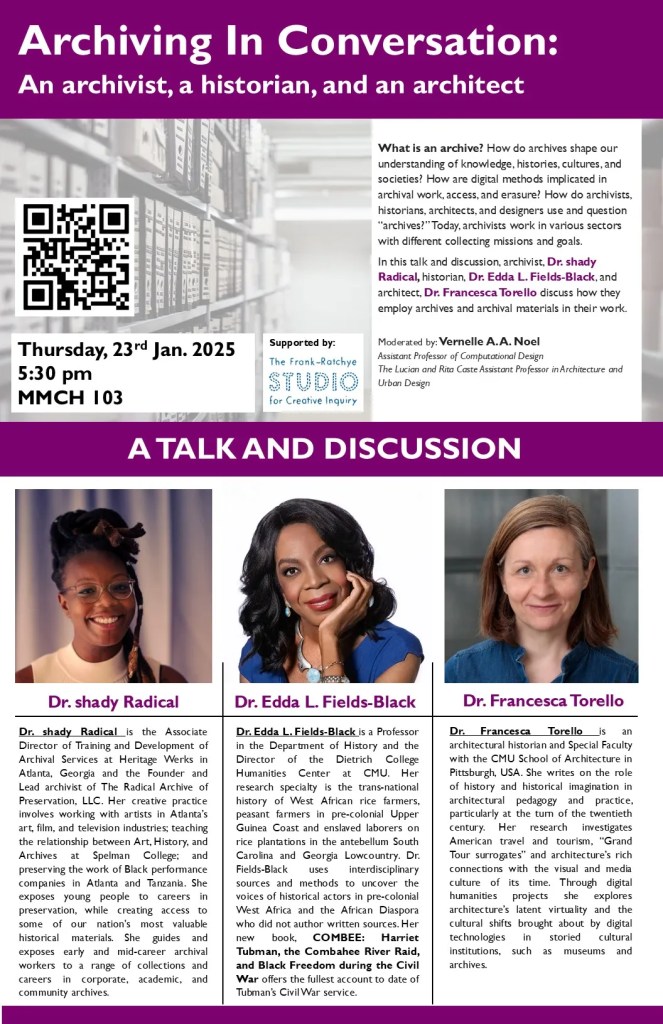
Dr. shady Radical is the Associate Director of Training and Development of Archival Services at Heritage Werks in Atlanta, Georgia and the Founder and Lead archivist of The Radical Archive of Preservation, LLC. Her creative practice involves preserving black memory, production culture, and women’s work while working with artists in Atlanta’s art, film, and television industries; and teaching the relationship between Art, History, and Archives at Spelman College. She is passionate about exposing young people to careers in preservation, while establishing standards, procedures, and protocols for caring for, building on, and creating access to some of our nation’s most valuable historical materials that live inside and outside of our bodies. Currently, she is working with Ballethnic Dance Company in East Point, Georgia and Bwagamoyo Africulture in Tanzania on new and innovative ways to bridge and fortify memory and diasporic relationships across vast geographic locations.
Dr. Edda L. Fields-Black is a Professor in the Department of History and the Director of the Dietrich College Humanities Center at Carnegie Mellon University and a Pulitzer Prize winner. Her research specialty is the transnational history of West African rice farmers, peasant farmers in pre-colonial Upper Guinea Coast and enslaved laborers on rice plantations in the antebellum South Carolina and Georgia Lowcountry. Throughout her career, Dr. Fields-Black has used interdisciplinary sources and methods to uncover the voices of historical actors in pre-colonial West Africa and the African Diaspora who did not author written sources. Her new book, COMBEE: Harriet Tubman, the Combahee River Raid, and Black Freedom during the Civil War offers the fullest account to date of Tubman’s Civil War service. This narrative history tells the untold story of the Combahee River Raid from the perspective of Tubman and the enslaved people she helped to free based on new sources not previously used by historians, as well as new interpretations of sources familiar to Tubman’s biographers. It is the story of Harriet Tubman’s Civil War service during which she worked as a cook and nurse in Beaufort, SC, and gathered intelligence among freed people and enslaved Blacks. It is the story of enslaved people who labored against their wills on seven rice plantations, ran for their lives, boarded the US gunboats, and sailed to freedom.
Dr. Francesca Torello is an architectural historian and Special Faculty with the Carnegie Mellon University School of Architecture. She writes on the role of history and historical imagination in architectural pedagogy and practice, particularly at the turn of the twentieth century. Her research investigates American travel and tourism, “Grand Tour surrogates” and architecture’s rich connections with the visual and media culture of its time. Through digital humanities projects she explores architecture’s latent virtuality and the cultural shifts brought about by digital technologies in storied cultural institutions, such as museums and archives. Dr. Torello holds a Masters from the interdisciplinary program in Architecture and Urban Culture “Metropolis” (UPC/CCCB), and a PhD in Architectural History, Urban History and Preservation from Politecnico di Torino, Italy.